
Is the Deck Stacked? How?
Real talk about how hard getting published can be and what to do about it.

Laying My Cards Out
All I ever wanted to be was a writer.
My parents insisted I become a teacher, and I bucked their goal at every turn.
Starting in middle school I spent my free period shelving books in the library. By the time I was fourteen, I worked a job at the public library in my little town.
In high school I poured all my free time and energy into the school newspaper and literary magazine. I killed the spelling bees. Nobody knew it, but we didn’t have a television at my house, and in my free time I was reading Walden and Les Miserables. Soon I was lined against a wall trying to out-spell every teenager in my state.
When I turned eighteen and went off to college, I flouted what my parents wanted for me and declared my major as English, Creative Writing.
Cutting and Dealing
I pushed and I pushed and I pushed. I submitted to literary magazines. I believed the things I was told and tried to be proud of rejections, because they showed how hard I was working.
I got an MFA. I got an agent. I got a book deal. It wasn’t earth-shaking, but it was a deal.
And then another. A different agent, another deal.
The Discard Pile
None of it worked great. Those years, I was always pushing. That was what I had learned to do.
Stephen Buhner’s metaphor of a wall is comforting—there is a wall and a writer is constantly pushing at it. A crack, perhaps a tiny crack, is going to appear. When the wall cracks, force your way through.
I think a wall is apt, but we also need to include a gate. For years and years I knocked and inquired and bowed down at gates. Sometimes the gatekeeper let me in. Sometimes not. If not, I searched high and low for the crack Buhner promised.
After a couple of decades, it got tiring.
What got tiring was a system of publishing that works against the writer. It’s a system that sometimes rewards sloth and banality. It’s one that pretends that a writer is not vitally important to a culture. One that doesn’t mind impoverishing its writers.
Playing My Hand
July 31, 2022 was the day a book of mine began selling on a do-it-yourself publishing platform. The book was The Woods of Fannin County.
That day I crossed a threshold, from pushing to be accepted to pushing to find my people.
When the next book was finished, I launched it on Kickstarter, then loaded to the platforms. That was Craft and Current: A Manual for Magical Writing.
I Have a New Kickstarter
Now I am launching my 11th book (my 16th if you count anthologies I edited.)
The Kickstarter for it went live last Sunday evening at 7:55. Numerologically, that’s 7:55 on 10-5-25. The Kickstarter will run for 20 days, until 10:25 on 10-25-25. Pretty cool, huh? And absolutely random.
Selling these first books in this way funds the book publishing project—a human cover designer, human editors, a human photographer and videographer, design software, audio-recording hardware, plus the apps needed for book distribution.
When the Dealing’s Done
The question I want to ask here is—in the publishing industry, is the deck stacked against a writer?
This weekend I was reading Mary Fruchter’s latest post on Pocketful of Prose. Mary is shopping for an agent, receiving a lot of rejections; she cites a statistic of a 1 in 6,000 chance of procuring an agent.
My guess is that the unreported number is far higher.
Another writer friend has finished a book proposal and is sending out query letters to agents, striking out a lot but stepping back up to bat.
Yes, the deck is stacked against a writer.
Why is it stacked? You know these reasons already.
Because a lot of us writers are lined up at the wall, pushing.
Because the wall is thick and impenetrable.
Because the gates are iron, padlocked, too high to scale.
Because the thing we offer—books—is a thing fewer people want.
Because the air is leaving the publishing industry.
Wild Cards and Jokers
If you’re pushing against that get-my-work-out wall, you may want to keep pushing, depending on your goals. Publishing the traditional ways offers a writer some sweet bennies: insider status, prizes, bestseller lists, assistance building an audience and a career, publicity, reviews, money in the bank. If you’re a professor, you are more obligated to stay in the traditional lane.
I have chosen to switch lanes.
Once I could see how badly the deck is stacked, I could no longer stand at a closed gate.
Don’t get me wrong. Succeeding at indie-publishing is not easy. It is arduous, exhausting, time-consuming. You have to do every little thing yourself or hire it done, with new systems every step of the way. The learning curves are cliff-like: How to Substack? How to find an editor? How to secure a great cover designer? How to load to Ingram Spark?
Plus, once you go indie, you’re an outsider writer.
But the deck is not stacked against you. You are in charge. You figure it out, you make it work, you find your audience, you serve them well, you watch the mark you are making on the world gradually grow.
You don’t stand beating your head against a wall.
You May Think
You may think, as a writer, that you’re reading the wrong Substack. The route I have decided to take is not the one you choose.
I’m not promoting indie.
In fact, I’m hybrid, meaning I publish both ways, and if the opportunity arises, I will publish traditionally again. If The Bitter Southerner wanted an essay tomorrow, I would write it for them.
What I’m promoting is you, me, and all of us thinking outside the box, trying to get out of the boxes we’re in, “boxes” meaning thought-patterns, negative beliefs about ourselves, limiting roles, and constraining habits. I’m promoting that we lift into the spiral that Gay Hendrix talks about in his book The Big Leap: Conquer Your Hidden Fear and Take Life to the Next Level, when he uses the phrase
out of the box and into the spiral
A spiral expands—a continuous, ascending journey. Hendricks’s Ultimate Success Mantra is, “I expand in abundance, success, and love every day, as I inspire those around me to do the same.”
All this gets me to my news.
One of the hybrid, out-of-the-box things I’m doing is once again launching a new book via Kickstarter.
I Have Launched My New Book on Kickstarter
During 2024, with the help of a lot of people, I produced a correspondence course called “Journey in Place.” It contained 52 Explorations, one per week, on how to
grow your sense of place
feel a sense of belonging
get more grounded
That year, a few hundred subscribers enrolled in the course. I promised that at the end of it they would receive a copy of the Explorations, compiled into a book. We finished the course Dec. 31, 2024. Now the book too is finished and this Course Edition of Journey in Place is being mailed to participants.
I Decided to Release a Trade Version
I wanted to turn the book into something for anyone interested in place, which I believe is a human obsession and also, for many of us, a soul-wound.
I decided to launch a Trade Version of the book via Kickstarter. The project went live Sunday night, 7:55 pm and will be live for 20 days, until 10:25 on 10-25-25.
Many of you have already supported this book. This morning I scrolled through the 100+ backers, and I see your names. Thank you so much.
If you haven’t had a chance yet, I hope you will check out what I have done. You can support the project for as little as $1 and as much as $1000s.
Glorious Thanks
I didn’t do the book alone. I thank the few hundred people who engaged in the 2024 course “Journey in Place,” whose ideas and opinions shaped the book.
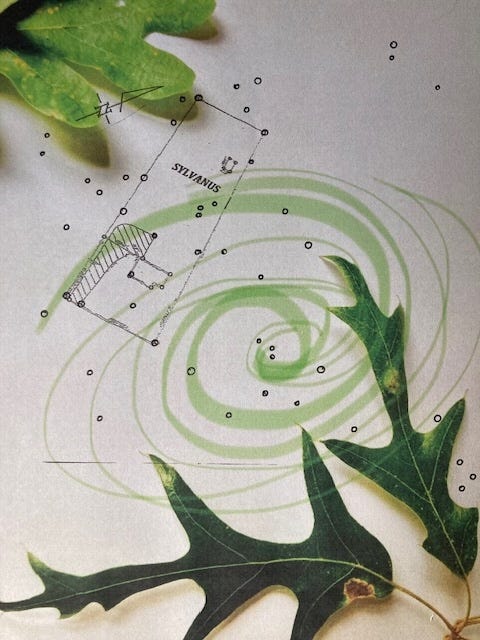
Thanks for guest posts by Stephanie Cornais, Sheila Knell, Sue Kusch, Jeanne Malmgren, and Catherine Young. Thanks to Julie Friar for her place-as-spiral art.
Thanks to my developmental editor Hilary Vidalakis, and to line editors M.K. Creel, Dallas Anne Duncan, and Sue Kusch.
Thanks to Flournoy Holmes for the witchy cover, which you can only see at the Kickstarter site.
Thanks to Silas Ray-Burns for photography and video production.
In Other News
🌀 Mallory McDuff Publishes in Time Magazine
To commemorate Hurricane Helene’s traumatic pass through Western North Carolina, Mallory McDuff wrote an essay, “After Hurricane Helene, Community Became Our Lifeline.”
Mallory is a friend and colleague. She is a professor at Warren Wilson College near Asheville and the author of five books, including Love Your Mother: 50 States, 50 Stories, and 50 Women United for Climate Justice and Our Last Best Act: Planning for the End of Our Lives to Protect the People and Places We Love.
I have known, admired, and loved Mallory for a couple of decades, and I’m very proud of this coup.
🌀 John T. Edge Is on Tour With His Memoir
My old friend John T. Edge has released his new memoir, House of Smoke: A Southerner Goes Searching for Home, with Penguin Random House.
My copy is on order.
John T. has been killing it with his book tour—massive audiences and sold-out shows in cities around the South. To see the lineup, check out this Instagram post. Tonight he’s in New Orleans.
This tour gives me tons of hopes for the power and far reach of books. These sold-out crowds prove that people still love books; still want to gather in bookstores to listen to authors and talk about books; and still want to read personal memoir. In-person book talks and readings are coming to life again.
We can learn a few things from John T.’s strategy.
John T. writes and hosts the National Emmy Award-winning television show TrueSouth. He is best known for founding and directing Southern Foodways Alliance. His 2017 book The Potlikker Papers: A Food History of the Modern South was named one of the best books of the year. Edge serves the University of Mississippi as a teacher, writer-in-residence, and director of the Mississippi Lab. And he serves the University of Georgia as a mentor in their low-residency MFA program in narrative nonfiction. He lives in Oxford, MS, with his wife, artist and friend Blair Hobbs.
🌀 NaNoWriMo Is Gone But Here’s a Replacement
NaNoWriMo, or National Novel Writing Month, was a nonprofit organization that ran an annual November challenge for writers to complete a 50,000-word novel draft, but the organization shut down in April 2025 due to financial problems and leadership missteps. (from Google)
Reedsy, which is a marketplace and support system for writers, has picked up the threads. It has announced the Reedsy Novel Sprint. Write 50K words in 30 days.
Ready to start?
🌀 Another Alternative from ProWritingAid
ProWritingAid is offering a replacement for NaNoWriMo called Novel November.
As James Blatch wrote in an email,
50,000 words in thirty days is a big task—an average of 1,667 words a day—but you’ll have an entire writing community beside you. And you’ll be supported with daily writing sprints, Q&As and craft webinars, with guests including Madeline Miller (Circe), Onyx Nwabineli (Someday, Maybe) and Rufi Thorpe (The Knockout Queen).
And the best part? Joining is completely free, and your participation also supports Room to Read, a global nonprofit bringing literacy and education to children in underserved communities.
Ready to go? Sign up here.
🌀 Lit Mag News
I’m keeping an eye on the Substack LitMagNews.

Janisse:
Is it possible that a Kickstarter campaign can be creative, beautiful, personal, and thoughtful, and nourishing? This is an engaging roll-out to your new book! I will be spreading the word.
Inspired and encouraged by you, as ever. Full of gratitude for you sharing your story and the pathways available to us all beyond the traditional. I love watching you midwife your amazing books out into the world xx